Archive for October, 2009

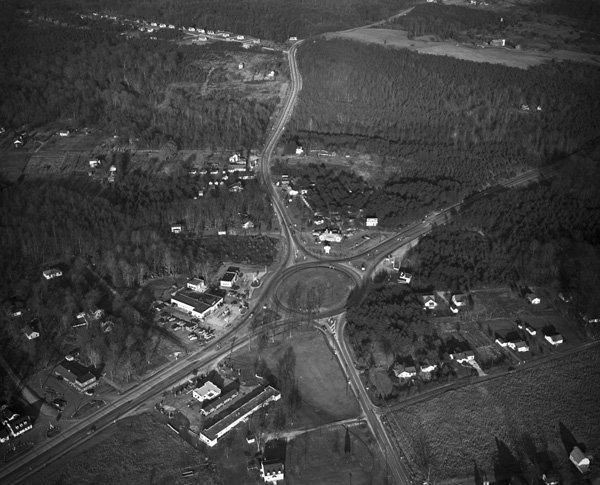
Undated Historic View of Fairfax Circle, Fairfax, Virginia.

[Image via The Library of Virginia.]

There has been a number of posts recently online decrying planning moves by Fairfax City that have been seen as anti-pedestrian and pro-vehicle. I believe that Fairfax Circle is the perfect place for Fairfax to make some planning changes that can be both car and pedestrian friendly.

As a driver in Northern Virginia I have long been confused by the not-quite circle at the intersections of routes 29 and 50. This confluence of roads is counter intuitive and dangerous for a number of reasons.

  • This is the point where routes 29 and 50 merge in doing so their names also change. This creates a confusing situation where the roads leading into the circle are (clockwise from the North) Lee Highway (route 29), Arlington Boulevard (route 50), Old Lee Highway, and Lee Highway (routes 29 & 50).
  • This circle has a series of lights, which effective kills any chance of it being a true traffic circle. This also makes merging into the circle difficult, because given the light cycle the circle may be filled with stopped cars which often create their own lanes.
  • Route 50 travels through the center of the circle, but there are no left turns allowed and the signage indicating this is quite confusing. Drivers who wish to turn left onto Lee Highway or Old Lee Highway have to first turn right and then proceed through the circle, stopping at the light at route 50, from which they just turned off.
  • To add to the confusion, left turns from Old Lee highway or Lee Highway onto Route 50 are allowed and encouraged.
  • Lastly, like much of the landscaping in Fairfax, the planted portions of the circle are useless. Until recently there were no protected pedestrian crossings into the circle, and once in the circle there are no benches or any public amenities to act as a public draw.

At least the pedestrian access issue has been solved. After some mysterious construction, pedestrian crossing signals have been installed on the right hand turn lanes onto and off from route 50. This is a literal step in the right direction, but there is still a long way to go to make this circle something useable and safe.

This circle is near the border of Fairfax County and Fairfax City and could be treated as a celebrated entry into Fairfax City; this could be achieved by restoring this to a real roundabout, with lights regulating pedestrian crossings and entry into and out of the circle and creating a park-like center with a statue or fountain similar to many of the DC circles. If the traffic along route 50 needs a direct access to the other side of the circle a below grade ramp could be installed; there is already precedent for this treatment in Fairfax County. The intersection of Fairfax County Parkway and route 29 has a multi-tiered intersection with an express bypass for traffic along route 29. I personally do not believe that an underpass would be necessary. During rush hour traffic crawls through the circle, and at all other times of the day, the local 35 mile per hour speed limit should be easy to maintain in a properly timed and lighted DC style circle.

A real circle here would solve many of the problems highlighted above. This new traffic pattern would be easier for drivers, safer for pedestrians and the break in the continuity of route 50 would help emphasize the change from Fairfax County to fairfax City. In addition, the shopping centers surrounding this circle attract a decent number of pedestrians, a park-like circle would provide them with some easily accessible green space.

Sphere: Related Content

Comments 1 Comment »

I was not able to post anything yesterday, because I had a job interview. Now I present you my weekly links of interest.

I have a new article on DC Metrocentric This one is a further exploration on my opinions of the Solar Decathlon.

In case you missed it last week, I wrote an article for Greater Greater Washington about using the Washington & Old Dominion Trail for a new VRE/Dulles Express line. This article kicked off a big discussion about metro and the silver line. You can see the rest of the articles here.

Archipreneur has a link to a presentation by Mickey Jacob, FAIA to House Committee on Small Business. This video highlights the goals of the AIA’s Rebuild & Renew Plan, which primarily calls on congress to make available low or no interest loans which would be useable for design fees as well as construction. This is the kind of boost that the A/E industry really needs to stay alive.

Treehugger has an article on a Prefab Portable Green Roof Installed In Toronto. I love the idea that companies could install removable green roofs on buildings that they are leasing without having to make permanent physical changes. In addition, I think this technology poses great possibility for low impact temporary installations.

The Floating House, by Morphosis Architect Thom Mayne, has received more traction within the news. If this design type becomes more common in New Orleans my personal proposal for the city would definitely be doable.

clips … Media/RealityA folding plywood seatA Modern sofa (I could swear I’ve seen a similar IKEA piece)

Sphere: Related Content

Comments 1 Comment »

Today I headed down to the Solar Decathlon on the National Mall. While there I was able to tour 15 of the 20 homes. I was happy to see that the Mall was crowded with people braving the wet and cold to visit these houses, even if that meant that the lines for some of the more award winning homes (like Germany and California) were so long that I chose to see 8 other houses instead of trying to get into them.

These houses all had innovative design solutions to create energy efficient and responsible homes. Interestingly enough, most of the homes used off the rack products, but just assembled them in innovative ways. Where I found the homes to be lacking was that most of them did not fully address their sites. Many of the homes did not interact with the portions of their lots that faced away from the main walk-way (those on the North were predominantly South focused, and those on the south were mainly North focused). Now I know a lot of this had to do with strategic window placement, but for homes which were little more than 15′x50′ rectangles it felt like opportunities to fully engage the site were lost. The teams DID engage the sites, they created decks, plantings and water features, but the houses often did not interact with these features.

One of the things that I found the most informative about the whole competition was not something anyone did, but rather what they were prohibited form doing. Most of the teams had integrated some form of waste water reduction technology through the filtration and re-use of gray and rain water systems. Unfortunately, they were not allowed to use these systems, because in DC it is a violation of plumbing code to use rain or gray water from anything domestic; it can only be used for landscaping needs. Apparently this is standard in many jurisdictions throughout the country. For a city that is trying to be more LEED friendly and at the same time develop its urban neighborhoods, this is a travesty. The student representatives at many of the buildings made it a point to highlight the water savings features and their inability to use them and encouraged visitors to contact their representatives to change this piece of legislation.

Sphere: Related Content

Comments 2 Comments »

It took me a while to find an app that could successfully translate any business card into a contact. I tried out apps that limited the number of contact fields and the types of fields (e.g., no e-mail addresses or job titles), but eventually decided to bite the bullet and pay the rather hefty price of $18.99 for Beach House Software’s CardSnap. This application will translate any business card regardless of orientation or text arrangement into an iphone contact. The only drawback is that it can take up to 24 hours, this is because the application sends the photo of the business card that you’ve taken with the iphone to a server where a “proprietary process for processing and mapping the cards” creates a contact without using OCR. Now as far as I’m concerned that proprietary process is probably an offshore customer service center in Bangalore, but it works and thats what’s important. I have had to correct one or two letters in a company name on occasion. But for the most part this is a great app. It is definitely a time saver, if you are willing and able to wait a day to have a full contact automatically created from a business card.

Sphere: Related Content

Comments 1 Comment »

I’ve always been a fan of transformer furniture, Treehugger has a post about an auditorium chair that transforms into a solid sloped plane when not in use. I could image using furniture like this to make a studio apartment have multiple uses.

Archipreneur highlights an apartment in NYC which is centered around a ribbon of concrete. I have long been interested in concrete in residential applications, and i feel that this project does a really good job of integrating the material into the space. I especially like the interplay of concrete, wood and brick.

clips …Build Blog has a post highlighting how to integrate both modern and traditional architecture into the same projectI love this Slope Sink on MaterialiciousSEPTA has some very cool benches comingIcebergs are stripped, who knew?

Sphere: Related Content

Comments 3 Comments »

So last night I had a really interesting dream. In it, there was a national requirement that once you received your architecture license you had to return to Architecture school for an additional “Comprehensive” studio, but this time include all of the practical knowledge that your license conveys.

While I have to say, the concept of being in the high stress world of studio again would be off putting, the opportunity to have an all out academic architectural discourse and project would be welcomed. I think this need to find a creative solution to a problem is the reason I got into architecture, and I have found more and more often lately that it is not part of the actual practice. Creative solutions are good, but they seem only useful during academic planning exercises. Instead, most people want proven quantifiable solutions. If only there were more Design Charettes that were open to public participation instead of by invitation, I think we would see a lot more inventive architecture.

Sphere: Related Content

Comments 1 Comment »

So, in addition to putting together our first permit set this week and having our first paint color consultation with a client, I have been feeling really sick. This is why I haven’t updated the last two days. I’ve been exhausted and had no appetite (yay! Weight loss!) and been having a series of fevers that give me a much better understanding of what women go through during menopause. At first I thought this was all allergy related, but after my first visit to an allergist yesterday (I’m allergic to dust mites, cats and all plant life here in northern Virginia) she seemed to think that it was something better suited to an internist to look into. So I’ve spent the morning being poked, stuck and x-rayed so they can try to figure out what is wrong with me.

I can’t help but think that a week ago I found out that I am an Architect, which at the time seemed like such a weighty matter and that it changed the course of my life. While now it seems like a small bump in the road compared to my physical well being. I just have to hope that they find it’s nothing major and something completely curable.

Sphere: Related Content

Comments 3 Comments »

There will be no update today, I am busy working on a deadline.

Sphere: Related Content

Comments 2 Comments »

Tree hugger has a list of 7 ways that the building industry can help reduce climate change. While many of the things on this list, like planning for people not cars and providing natural ventilation, are standard ideas for anyone who has been to architecture school since the 1970′s, this list is a great summary of changes that can and should be made in our building culture.

I am in love with this office in a steam trunk design. This reminds me of the new hotels for global nomads exhibit I saw at the Cooper Hewitt a few years back, and some of the steamer trunk designs that were a part of that show. What makes me really like this concept though, is that it would be great for the urban apartment dweller. When its time to change apartments, all you do is closet the trunk and wheel it away. Plus if you have a studio you can have an instant office when you need it.

Morphosis created a houser for the make it right foundation that can float on piers up to 12′ off its foundation. This is one of the best proposals I’ve seen so far. Architecture aside, this kind of reactivity to the natural condition is what is needed if New Orleans wants to survive future hurricanes. This design could be integrated into the proposal I wrote for a new New Orleans a year ago.

Clips … photovoltaic barrel tileswood veneer furnitureplaygrounds from the 1970′s

Sphere: Related Content

Comments 1 Comment »

This morning I went to a client consultation in Baltimore. While there we wandered for a bit around the Fell’s point district in addition to the neighborhood where the client’s property is (near John’s Hopkins Medical Center). I have to say, that my opinion of “Charm City” is not necessarily a good one.

This is my third trip to Baltimore, and while tourist areas like the Inner Harbor are clean and well maintained, I have a hard time liking them and the city as a whole. The clean-ness feels forced, especially in comparison to the rest of the city, which feels like the bastard child of Philadelphia and DC. The streets are wide like in DC, but there is very little green buffer between the buildings, the sidewalk and the street, like in Philadelphia. The neighborhoods and streets seem to quickly merge from one indistinct area to another, and while doing so they don’t really seem to retain any sort of character, unlike the distinct neighborhoods of DC. In Baltimore everything just feels grimy. This is not to say that the Fell’s point district wasn’t lovely. It just seems to not quite be lovely enough for such a posh neighborhood.

In addition, the Preservation movement and gentrification have come late to Baltimore. There are large parts of the city that seem destined to crumble in on themselves, and with the near housing collapse I have to wonder if these areas will ever get a revitalization boost. That is not to say that there isn’t architectural wonders to be found here, because there are. But they will need a good deal more rehabilitation than most areas of DC. This is not helped by the general lower standard of living in Baltimore than DC and the relatively poor mass transit system.

Maybe I just haven’t been in the right part of town.

Sphere: Related Content

Comments 4 Comments »

Content recommendations from Evri