Archive for May, 2008

I’ve been out of town for the past two weeks and had nary a moment to read architecture stories, let alone compose a post of my own criticism or comments. Sometimes the real world seems to not want to let me get back to the virtual one.

So instead, as my welcome back post, I thought I would post a link to Eikongraphia’s Most Popular Architecture Blogs of 2008. This is really a best of the best list, look for future articles to be sourced from these blogs (and their coming addition to my links list). Maybe one of these days I can make this little side project into a top 25 worthy entry.

Sphere: Related Content

Comments No Comments »

So I’ve been digging through the archive of articles that I have meant to write about, but have not had the chance and came across this article from boston.com which discusses Green Roofs, specifically the the American Society of Landscape Architects (ASLA) in Washington DC, and discusses their popularity in Europe and compares them to standard roofs.

Green roofs are one of the areas where building design in the US lags behind the rest of the developed world. In Europe, green roofs are more ingrained in the culture, for lack of space and in the northern climates, as a pre-modern cultural adaption. It has only been recently that this urban parkland has been identified as a environmental boon, and not just a social one. In the US contractors balk at putting dirt, substrate, plants and a drainage method on a roof, complaining that ti will be too costly, need more structural reinforcement that the design calls for, and pose greater chances for leaks. Yet rooftop gardens have been a fixture in NY for years and not just in skyscrapers.

But green roofs should not just be urban elements. The suburban strip mall is perfect for green roofs or PV panels. The large expanses of asphalt and the traditional tar flat roofs can create suburban heat islands to rival their urban counterparts. Plus, it would be a good marketing ploy. Imagine if Target decided that to show its environmental awareness they would plant a green roof on every store, and whatever rainwater seeps through the soil, will be collected in a brown water storage system and used to flush toilets and urinals. Not only would they reap the benefits of lower heating/cooling loads and less municipal water use, but they would also bring in many customers looking for an “environmentally friendly” shopping experience.

Sphere: Related Content

Comments No Comments »

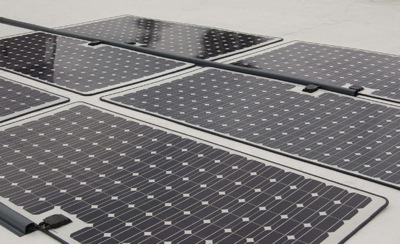
Lumeta PowerPly PV Panels

[Image via DRI Energy]

So I have been studying for my LEED AP exam lately, so my interest was peaked when I came across this article online. Apparently, DRI Energy has come out with a product called Lumeta PowerPly which adheres directly to the roofing membrane instead of being mounted on an expensive and heavy roof structure, which is one of the prohibitive cost factors in the implementation Photovoltaic Panels. I imagine that this application will have less of a yield because it is fixed to the angle of the roof than rack mounted systems, which can be tuned to face an optimal angle or even rotate and tilt to follow the sun.What is lost in yield I imagine can be made up on roofs that would normally not be able to handle PV panels (such as curved roofs and steep pitches). In addition, I would worry that since this bonds to the roofing membrane, if there is a membrane failure the PV panels will need to be replaced as well, instead of being able to be removed and remounted in a traditional system.

I knew that this technology was out there, but I was unaware that it was already being marketed. I think that this kind of application process could definitely help bring PV panels and solar energy use to projects that would normally not even consider it.

(And in case anyone is wonder, no they aren’t in rainbow colors and are not actually made by Lisa Frank)

Sphere: Related Content

Comments No Comments »

The New York Times ran an article about an architect who used a glass stair in his home to open it up and create more light. Glass stairs are nothing new to commercial architecture – they’ve been around for many years before Apple* built one in their iconic SoHo store in NYC, but they are relatively new in residential construction. Part of the reason for this is that the structural components for a glass stair like the one in the article (a concealed steel structure) are not commonly used in American stick frame architecture. Wooden stairs, though much less transparent, are less expensive, and thus tend to be the the de-facto choice, even under skylights.

The thing that i find interesting about this article is the introduction of typically commercial elements (glass and steel) into a victorian townhouse. I noticed that the article makes no mention of the historic preservation / adaptive reuse element of this story, nor does it question the merits of completely transforming a house of this age in this manner. I’m not saying that i think it was the wrong move (i don’t know the full scope of the architecture) but from the accompanying images it seems as if the remodeling has thoroughly removed any traces of the house’s former life. Such a drastic move as this always makes me wonder if there was a more subtle way of adapting a house such as this to the needs of the occupants?

* – It should be noted that Apple’s iconic stair is a self supporting glass stair – there are no hidden steel support stringers, the glass is supported by a glass wall below.

Sphere: Related Content

Comments No Comments »

This past weekend the Washington Post ran an article in their magazine describing one man’s trauma renovating his kitchen. It has some very negative things to say about the architect, the contractor, and the building process as a whole. It is obvious that there is blame to go around. Yes, the architect made poor design decisions and the contractor had his errors as well; but speaking as a member of the profession, I feel that the greatest problem here is with the public conception of what is the job of an architect.

It is very clear what a contractor does. They interpret the architect/designer’s plans (or owner’s description) into a real built environment. Thats it. They may hire out subcontractors, manage time, and coordinate, but their number one job is to build.

An architect’s number one job is to plan and oversee, not, as commonly believed, to design or create. Yes, part of the planning process is the creation of the original design with the input of the owner, but the real job of an architect (or at least a construction/production architect) in the US today is to make sure that end result conforms to code, performs within reasonable expectations (doesn’t leak, has adequate HVAC ,has the proper plumbing hookups, is structurally sound, etc – the actual design of which may be outsourced to engineers depending on the size of the project), and is to the satisfaction of the owner. It is not to come in under budget or ahead of schedule, or even on time. These are commendable goals that every architect should strive for, but they should not supersede the needs of a building that just WORKS. This management roll is why an architect is/should be involved from the day the project begins site selection until the owner has the keys in their hand.

All of this sounds fine, until, like the tinkering of a a mad chemist, you combine a contractor and an architect. The ensuing relationship may (albeit very rarely) be one of silky smooth communication and efficient construction, or (not as rarely but still not usually) an explosive clash of interests and egos the likes of which the senate chamber has never seen. Usually, the result is a sometimes friendly, sometimes adversarial relationship where the contractor spends a lot of time undoing and redoing work. This is mostly due to a breakdown in communication and some key issues that are overlooked 99% of the time. Without going into the in depths mechanics of construction administration, it will suffice to say that a contractor must submit everything to the architect for approval before it is built, while it is being built, and after it has been built. This process usually has holes due to time or budget demands and a desire on the part of the contractor to increase their profit. Contractors want to have as little time spent waiting for approval as possible and owners tend not to want to pay architects to continually visit the job site and oversee the work of contractors. Because of this, details like window flashing (waterproofing at exterior surface penetrations), movement joints, insulation, and anything else that gets hidden tend to get constructed improperly. There are many reasons for this (lack of skill in the installers/staff, errors in the documents, a desire to cut corners, etc) but as far as the owner is concerned they all look the same: “perfectly good work” being torn out because some “fussy” architect has to have everything his way. This isn’t to say that there are some cases where the architect is being overly cautious/anal retentive, but in the sad state of modern practice, it is usually the architect trying to prevent themselves from being the subject of a lawsuit when your new skylight leaks all over your original mid-century modern rug and ruins it.

Something else that is easily ignored is the power of the purse. Owners should never pay contractors without pay authorizations going through the architect, and these should be based on percent of work completed, not an arbitrary timetable. This allows the owner to accurately pay for work rendered; this way incase there is a cessation of work – for natural or legal reasons – the owner has not overpaid the contractor. This goes double for the end of a job, the owner needs to hold off on the final pay authorization until the architect has ran a final punch-list (a checklist of issue that need addressing) and can vouch that the project is completed.

All of this goes back to a post I wrote at the very start of this blogging experiment – courses in the bureaucracy and business of home repair/renovation for homeowners just like the mortgage seminars some home buyers must take. Owners do not need to be infinitely involved in the day to day issues of construction, this is one of the reasons to hire an architect or a construction manager, but they should know be comfortable knowing that an architect may seem to be wasting their time but they are really protecting their interests. Such seminars could, in a single half hour session, help to clear up these misconceptions and also help home owners to realize the value added by hiring an architect in the first place.

The author closes his article stating that before you renovate, make sure you know more about construction than your architect or contractor. This is wrong, owners do not need to know how things work, what they do need to do is to be prepared for their 1 month renovation to stretch on for a year. It is essential that an owner understand that no time estimate is definitive and that in the end it is better to wait for a new kitchen that functions than to have the project delivered on time and be of sub-par construction. The old adage IS right: good things come to those who wait.
Sphere: Related Content

Comments No Comments »

Today The Washington Post reported that the rumors of the demise of the Dulles Metro Extension were greatly exaggerated. Of course, this does not mean that the funding is free and clear, it just means that the project has not been scrapped and it will continue, with certain requirements to be met.

For those unfamiliar, this project is a rail extension for the WMATA run METRO’s Orange Line. The new line would run out to Dulles Airport, the main international terminal for DC, which is currently only reachable by Bus, taxi, or personal vehicles. This extension would also service the towns between the end of the orange line and the Dulles Airport, a heavily developed stretch of land that currently has very heavy commute times into and out from the city.

This is some of the best news for Northern Virginia and the DC metro area in a long while. There has been rampant speculation in the housing and development markets in regards to locations of future metro stations; this was all in great danger of collapsing after some recent articles warning of the possible death of the project due to federal oversight and fears of a bloated budget. If the speculation did not pan out, this could have triggered another horrible fall in the local housing markets, and could have meant many more foreclosures. Also, the extension will provide greater rail access farther west from the city than is currently available and may help alleviate some of the beltway and commuter traffic. If this project is successful it will bring with it hope that commuter rail solutions to traffic in Northern Virginia could be a reality and that the fable purple line (a ring line around the city) might one day be constructed.

Sphere: Related Content

Comments 2 Comments »

Recently I have made a number of posts regarding green buildings and the paradigm shift which will be necessary if we are even going to have a truly green architecture (see posts here and here). I bring this up again because i recently read two different articles online from two different architectural professionals from two different cultures, Martha Schwartz – a Boston & London based landscape architect and Harald Bodenschatz – a professor of Sociology and Planning in at the Technische Universität in Berlin and they both discuss similar goals for a more environmentally friendly development. Schwartz focuses on the urban landscape and its development (or lack thereof) currently as opposed to in a truly green environment, and Bodenscahtz focuses on the development of inner cities and suburbia as sustainable growth tactics and in such a way to help the European city thrive.

While neither of these articles explicitly states my previously argued hypothesis (that in order to be a truly sustainably designed society we need to increase our population densities and thus maximize our transportation schemes), both provide intellectual support to my arguments. Without a new 21st century version of urban renewal – one which is culturally, environmentally and economically sensitive – we will never be able to sustain our growth and development. This collapse in infrastructure is one of the issues facing us today, and it is potentially more threatening than global warming, rising oceans, and food shortages. With more people in the suburbs there are more cars on the road, the more cars the more wear on the roads. The more cars, the higher the demand for and thus the higher the price of gasoline, and the higher the demand for gas the less money available for other “necessities.” Greatly improved mass transit systems could alleviate the strain on our fuel supply and roads, while slightly increased mass transit systems but planned suburban clumping and urban densification could easily have the same impact.

Sphere: Related Content

Comments No Comments »

Content recommendations from Evri