Architect as artist

In the past century we have seen the rise of polytechnic architecture, a method of building which divorces the architect from the world of art and creativity, and instead treats buildings as solutions to engineering problems and casts architects in the role of project managers, facade coordinators and space planners.  Working and living within this modern paradigm it can be easy to forget that our profession is not just about ensuring the health, safety and welfare as our licenses require, but also about creating spaces that inspire and capture the imagination.

The New York Times has an interesting article describing a new exhibit of sketches by Frank Gehry at the Princeton University Art Museum which help to remind us that architecture is more than creating big boxes for commercial and residential means. While I am not a huge fan of Gehry, and feel that he is more popular for the “cool” factor of his buildings than for the real reason he should be popular – that if you consider the sum total of his works as one examination in form, it is a very interesting exercise in mass and volume and the delamination of these masses and volumes, I am glad that someone has started a discourse about the art form that architecture once was, and could still be. The real issue here is not that too few architects sketch, but rather too few architects are given the freedom to explore and create works of art. Instead they are directed to design to meet a specific style (and sometimes meet public approval) and then produce a building within (or under) budget while creating drawings that assume that the construction team will have no knowledge of how to build a building so as to limit their legal exposure. This creates buildings that have a watered down aesthetic and take few risks.
Corbu, who?

Tomorrow is Black Friday, which means that the Holidays are right around the corner and with them comes the chore of finding the perfect gifts for those you are about. If you are searching for that modernist (or anti-modernist) in your life, you might think that the new biography of Le Corbusier by Nicholas Fox Weber would be the perfect gift. Hold back though, if Phillip Kennicott’s review in this past Sunday’s Washington Post Book Revue section, has any bearing, this new biography of one of the most famous and central figures in the modernist movement, Le Corbusier, might not be for you.

Of course, in this biography the author, Nicholas Fox Weber, spends much of the book focusing on the swiss architect’s poor behavior and fundamental dichotomies between his architectural vision and personal opinions. Kennicott’s review skewers the author complaining that the book is poorly written and almost unedited. In addition, it is his belief that while there deserves to be more written about Le Corbusier, this book focuses too much on the man and his accomplishments, and not enough on the resistance to his revolutionary ideas.

LEED, the trials and tribulations of the Green Revolution

I just finished reading an article on the Wall Street Journal’s site about the green building movement and the practical issues faced with training professionals and navigating an unstable and untested market. As a design profesisonal who keeps putting off his LEED exam in favor of other equally worthy endeavors, this article hit home. The problem with green building right now is that the market is so new and untested both for professionals and for the products. The article describes a situation similar to one I recently faced at work. An architect specified a Green product that ended up not being reliably available which caused delays and impacted budget. In the end litigation was reached. Fortunately, in my situation we were able to determine that the LEED point was unattainable even with the specified product, and that we were well within our target status (silver) so a non-LEED approved solution was found which allowed the budget and schedule not to be impacted.

This type of problem is rare in proven markets, when was the last time you heard that concrete or brick was not available? And when they are not, an alternative product usually exists and can be used without detriment to the project. The problem with the current state of Green products is that in some divisions (parts of the construction trade) there may few choices that help qualify for points, and each choice can qualify for differing points, so an alternative product may be the same monetary cost but may cause you to lose LEED credits. All of this coordination (and possible legal exposure) is one of the main reasons that LEED projects demand a high premium on the design fees.

The other major reason for the premium that LEED projects (or Green projects in general) carry (besides the increasing demand) is that the supply of trained professionals is just not enough to keep up with the demand yet. The LEED exam, while well within reach for anyone who is good at wrote memorization, is a barrier for many to achieving LEED-AP (Accredited Professional) status. In my case, every time I start to study for the exam something more germane to my career comes up. The first time it was focusing on completing my IDP, now I am preoccupied with studying for my licensing exams. Once I finish those, I am sure I will be concerned with getting my continuing education credits. Now I know these don’t take up all my time, but as opposed to when I was a student, I have more pressing things to do in my free time than read and memorize a 500 page book for instant recall. I guess the point I’m trying to make here is that, yes professionals know that we SHOULD get accredited, but until it becomes a necessity of our field, or we are offered increased compensation for our accreditation, I have a had time believing that supply of LEED accredited professionals will catch up with demand.

Adaptively reused Circuit Cities, here we come!

With the recent closing of many of the area’s Circuit City stores and the bleak financial forecast, this Sunday’s Washington Post article about what to do with big box stores after they close down, seemed to be fortuitously timed to impact the local planning discourse. For this article, the Post assembled a collection of local architects and artists, such as Darrel Rippeteau, Roger K. Lewis, Esocoff & Associates, et al., and asked them how they would reuse a big-box store.

The graphics in this article are intriguing and open an sub/urban planning discussion on what to do with the trappings of early twenty-first century American development once this business model has changed. The proposals include luxury housing, gardens, vineyards, and other adaptive reuse measures. This is all green and good, but I have to question the safety and cost of reusing these big box stores. Like fast food franchises, big box stores are not built to last. They are not constructed with any concept of their permanence, instead they are meant to go up quick and cheap and come down the same way when the new mega-ultra-super mart opens around the corner. The advantage of reusing old warehouses and factories is that theses large masonry structures were built to last and much of these structure can be re-purposed for less a strenuous program. This advantage would not be present in the Circuit Cities which will soon find themselves lacking a purpose.

There was one proposal that stood out to me, instead of re-imagining the big box store, it adapted the parking lot to a more urban context. The design called for two “linear buildings” surround a “parking module.” This strategy is closely related to one of the common forms for multifamily construction – the Texas Donut. In this strategy the parking garage is surrounded by the program, hiding it from view and creating a “safe” place for parking. This is a strategy that has become quite common in urban fringe development and could be beneficial in creating density within the big box context. The other reason this strategy caught my eye is that in my Thesis project for architecture school, I repurposed the parking lot of a Wal-Mart in New Orleans to create a public plaza and a municipal library. Part of the goal of my project was to acknowledge the big box stores as the modern equivalent of the urban market and to reintegrate them into the civic context.

Kandinsky, Lissitzky and Goncharova, OH MY!

This past Sunday, the Washington Post ran an article about an exhibit of Russian porcelain figurines. From the author’s description I can imagine that when approached with the right mindset, this would be a very interesting exhibit, especially if there was a historiographical entry for each piece explaining the popular and political culture from its time period.

The issue I am righting about this article is not because of the exhibit, but rather the assertion the author makes in the first paragraph; that while Russians may have excelled at the audible arts, they have never been any good at the visual arts. His assertion is that at best they were aping french and at worst they were downright rustic. This thesis is fundamentally flawed.

Pre-modern Russian visual arts were tightly controlled by the Orthodox church and focused on the creation of Iconography. These religious symbols show a mastery of coded expression, much like catholic religious art from the same period. While during the early – mid 19th century it may be true that Russian art followed the french romantic schools, in the late 19th and 20th century everything changed. Russian artists started exploring non-representational art and geometric and cubist art in ways that Western Europeans did not reach for decades. The cylindrical forms of Kasimir Malevich’s Taking in the Harvest evoke early computer art and three dimensional renderings. Natalia Goncharova moved easily from naive through cubism to futurist styles, while the pure forms of Lissitsky’s work from the 1920’s could be confused for 1950’s American artwork and his faux architecture can be confused for the post-industrial towers. The middle work of Kandinsky is often praised for its dichotomy of color and forms with the stark realities they are portraying, while his latter work predates Jackson Pollack by decades but could easily be mistaken for one of his splatter pieces. And this is just three of the avant-garde artists that arose in Russia between 1860 and the rise of the Soviet Union.

While it may be true that Russia does not have the centuries long art culture that France and Italy have, it cannot be overlooked that they were the shinning star of the Modern art world before Communism squelched individual expression. To deny them this period of cultural exploration would be unjust.

Preservation’s Choice

The New York Times has a brief article about a church that could not afford to expand on their historic structure, and so instead worked a deal with a developer to get space under a new highrise. In addition, neighborhood improvements were also carried out. The article poses the most poignant question that preservationists must face: is the historic architectural fabric more important than the quality of life of those who inhabit the spaces?

This question is really the crux of modern preservation. With modern laws and sensibilities homes and structures relating to famous people will be saved and preserved, it is the fabric and architectural experiments of the nameless faceless crowd that really make up our architecturally history and too often they are pushed aside for progress. In the case of this article it IS sad to see such an interesting structure fade into the past, but then again is it worse to see a community die around a building like this? The issue here comes down to a matter of means, if it was possible the church should have found a developed willing to build a building that would create architectural interest and install a plaque/display about the old building. That way, even though some of the history would be lost, it would not be forgotten, and the new building would have the potential of filling the same architectural niche that the old one did.

From Highboy to Turbine

bookcase stair

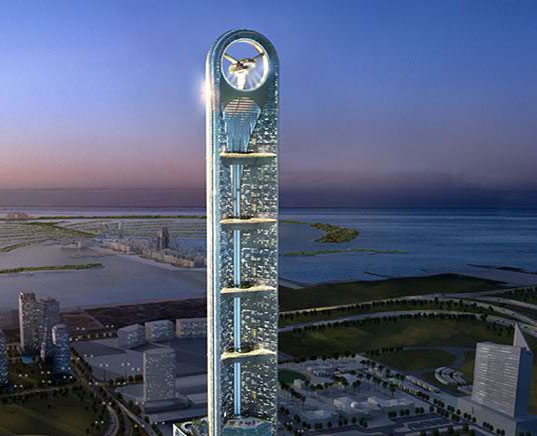
[Image via Inhabitat.]

So it looks like Dubai is approaching its Po-Mo phase, Philip Johnson beware!

In an almost deferential move, there is a new building slated for construction that looks like a Turbine (see this post at Inhabitat). Instead of going the Masdar route and building a building that generates its power, this building just refers to the shape of turbines as a way of co-opting the green building trend and making it a design statement. In place of power generation, the “turbine” will generate spectacular views of the desert mirage that is Dubai for the dinners in its floating restaurant.
It is interesting to note that the design firm that built this project Atkins Design is responsible for many other projects in Dubai and the arab world including the Burj Al Alrab and the Jumeirah Beach Hotel. One of their projects which I have wrote about in the past is the Bahrain World Trade Center, which has three actual turbines that generate power for the building.

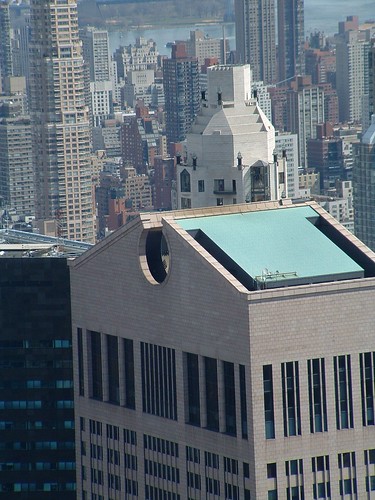
Philip Johnson's AT&T Building

[Image © rieteree all rights reserved.]

The reason I bring up Po-Mo and Johnson is that this project in Dubai seems such a blatant progeny of his AT&T building (now Sony building) in NYC. This building was meant to evoke the prestige and Americana patriotism of a Chippendale Highboy in the treatment of its roof line. Much like the Vana Venturi house brought post modernism to the home and hearth, Johnson’s AT&T building brought the language of Post Modernism to commercial construction. No longer were smooth glass boxes a la mode, instead references to historic forms were used to tie companies to abstract ideas and emotions.

It will be interesting to see if this new tower in Dubai will change the architectural discourse further. Instead of just buildings referring natural elements such as flames and water droplets (Champana’s Dubai Towers and The Shanghai Cruise Ship Terminal) this new building takes it a step further and refers to power that these natural elements can generate without actually generating it. This contradiction seems to say “Hey look at me, I’m cool, I’m a green product, but not really – I’m so hip I don’t need to be green.” Taking this to its natural conclusion, might we start seeing buildings decked out with “faux-to-voltaic” panels and AstroTurf green roofs? If Dubai is the new New York and considered a barometer of the commercial architectural zeitgeist, we just might.

The Panic of 2008

Check out my sister’s op-ed piece on the similarities and differences between our current political situation and the Panic of 1837 on The History News Network. Its a really interesting read.