Architecture School

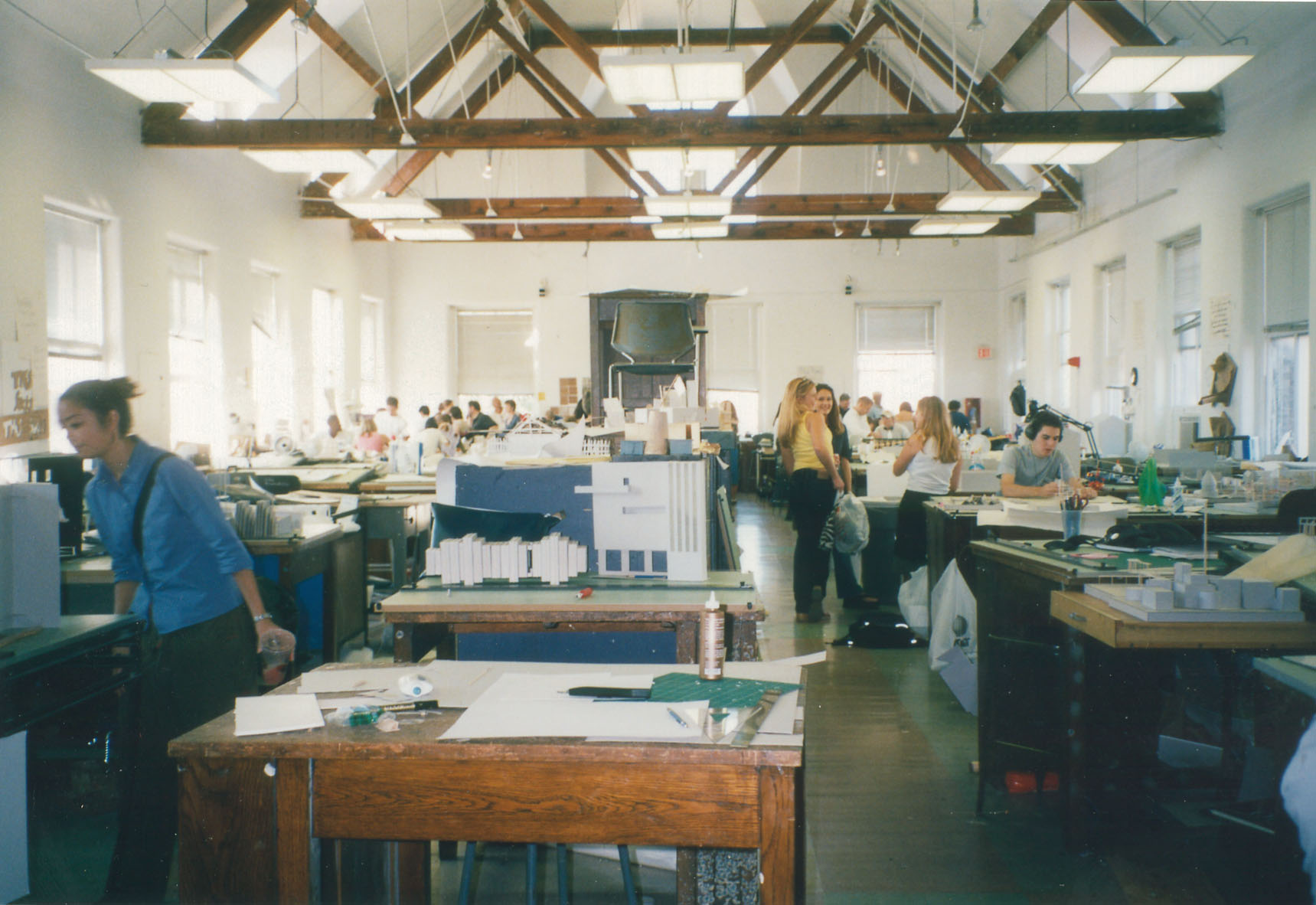
1st year studio at Tulane School of Architecture, circa 2001

So I just got done watching the first episode of Sundance Channel’s Architecture School.

I have to say, for the first reality TV depiction of the world of architecture education, and especially the Tulane variety, it is starting out as a decent representation. They managed to capture the ever condescending tone that most professors use towards their students as well as the tensions between rich and poor, black and white, and Tulane and the city; issues that have always inhabited New Orleans even before Katrina. I have to say, one of the things that is severely missing is the sense of height and lack of air conditioning in the architecture building – Richardson Memorial Hall, and the oppressive humidity that I am sure is plaguing these students in the field. With it being the first 2 weeks of the semester, it has to either be August or January and it doesn’t really look like they are dressed for January in New Orleans. C’mon Sundance Channel, where are my sweaty dehydrated daiquiri sipping architecture students?

Let me also add, that it is totally surreal to watch not only people that you know but buildings that used to be central to your life on TV. It has sparked in me a real desire to move back to New Orleans, maybe one of these days my life will take me back there.

Flat packed boxes made of ticky tack all look the same

This Sunday the Washington Post ran two different architecture/design articles, one about the MoMA prefab housing exhibit – “Home Delivery: Fabricating the Modern Dwelling” and the other about IKEA’s new catalog and its pastiche of Modern and Classic styles.

Both articles dwell on the nature of consumerism and mass production in our modern world, but from highly different angles. Philip Kennicott is quite deliberate in his discussion of the evolution of manufactured housing, from the early portable emigrant cottages through the era of Sears and Roebuck to the famed Modernists (with a capital “M”) Le Corbusier and Moshe Safdie and on through a contemporary piece designed by Richard Horden and Haack + Hoepfner Architects. Through this history lesson he also grapples with the two sides of pre-manufacturing/pre-fab, the mass produced bland utilitarian home and the architectural object d’art democratized and brought within the public reach. In the end he ends up questioning whether pref-fab can ever really be the answer to the Design like you Give a Damn movement, or if it will be the next wired-tired-expired status symbol.

Chairs at IKEA

[Image via Peter Morgan published in accordance with creative commons attribution license.]

This Sunday the Washington Post ran two different architecture/design articles, one about the MoMA prefab housing exhibit – “Home Delivery: Fabricating the Modern Dwelling” and the other about IKEA’s new catalog and its pastiche of Modern and Classic styles.

Both articles dwell on the nature of consumerism and mass production in our modern world, but from highly different angles. Philip Kennicott is quite deliberate in his discussion of the evolution of manufactured housing, from the early portable emigrant cottages through the era of Sears and Roebuck to the famed Modernists (with a capital “M”) Le Corbusier and Moshe Safdie and on through a contemporary piece designed by Richard Horden and Haack + Hoepfner Architects. Through this history lesson he also grapples with the two sides of pre-manufacturing/pre-fab, the mass produced bland utilitarian home and the architectural object d’art democratized and brought within the public reach. In the end he ends up questioning whether pref-fab can ever really be the answer to the Design like you Give a Damn movement, or if it will be the next wired-tired-expired status symbol.

Blake Gopnick, on the other hand, is a bit more free flowing in his exploration of the international Swedish design giant’s latest catalog. He discusses the reality of IKEA as a means of bringing the Modernist ideal of clean lines and democratic affordability to the American (and worldwide) domestic market, yet this aesthetic ideal is lacking the revolutionary spirit of the Modernist movement. A Poang bares no ill-will towards a Louis XVI settee, whereas the Vasily Chair seems almost murderous in its purpose. An interesting counterpoint that Gopnick brings into his article is Design within Reach, The Henri Bendel to IKEA’s Target. Whereas IKEA is is synonymous with cheap comforting (if not comfortable) furniture, Design within Reach (or DWR to those in the know) is all about status. The name is almost a farce, whereas IKEA is within the reach of college students, DWR is within reach of the DINCs (double income no children). What intrigues me though, is where Gopnick takes us in closing. In discussing both of these mass produced furniture solutions he is left feeling that in the end there is still only two options, Modernism and Pottery Barn, or as he more succinctly puts it:

There’s not much to take modernism’s place out on the cutting edge. The movement may not be as fresh or lively as when it started out, but it’s still less tired than faux Chippendale or neo-Colonial cherry or most other options out there.

So where does this leave me, well for starters I find it totally intriguing that both of these articles leave us with the idea that there are two contemporary mass produced forms: the object and the tool. One is a method of achieving comfort or shelter, but provides no real idealistic statement, and the other is a fully realized statement but still prohibitive in its availability; think the iphone versus the blackberry. The second issue I have is that both of these articles seem to have no concept of a post-modern design esthetic, there is no concept of design as irony. Kennicott at least deals with the a contemporary housing model, but Gopnick completely misses the world of Frank Gehry’s Wiggle Chair or Karim Rashid’s sensuous curving chairs. I also have to wonder what he would make of MUJI‘s utilitarian housewares which ARE much more affordable than DWR but still evoke the starkness that Modernism was striving for. Lastly, both authors dance around the issue, but never really question whether this whole mass production is even a good thing. I have to wonder if Big Box Architecture is not just a symptom of the early 21st century and the American Rocco period of excess, and we would be better suited emotionally, spiritually, and globally if we sought economical design solutions that responded to individual needs. With its simple lines and Iconic nature it is easy to forget that the famous Modernist furniture of Marcel Breuer and the Ludwig Mies van der Rohe were responses to external stimuli, and not universal solutions for seating.
Critial Olympianism

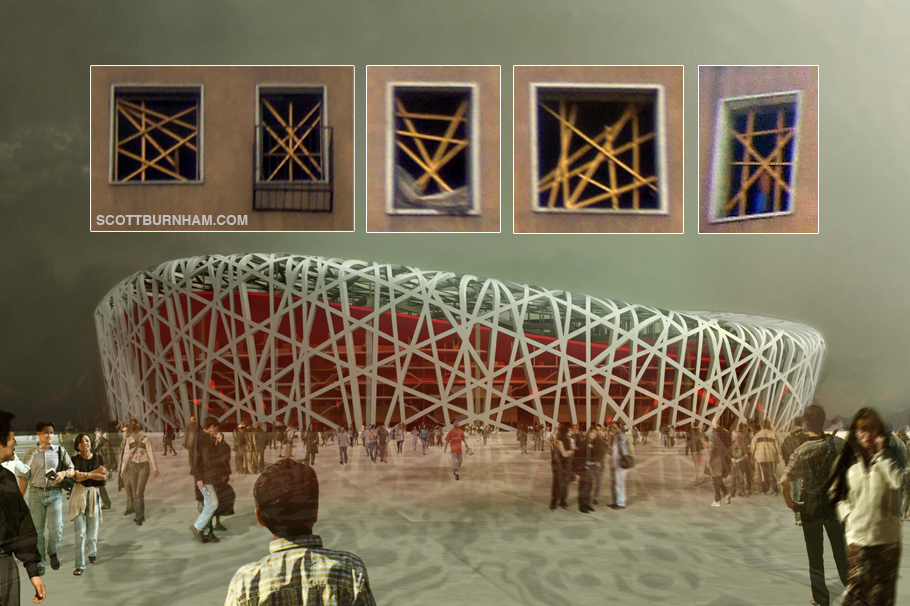
SCOTT BURNHAM has a realy good post about the Beijing Stadium. He contends that the now ubiquitous “Bird’s Nest” shows a striking similarities to the improvised safety screening that Chinese migrant workers erect in buildings. This woven mesh of slates IS eerily similar to the form of the outer skin on Herzog & de Meuron’s Stadium.

Stadium vs Improvised Safety Barriers

[Image via SCOTT BURNHAM.]

SCOTT BURNHAM has a realy good post about the Beijing Stadium. He contends that the now ubiquitous “Bird’s Nest” shows a striking similarities to the improvised safety screening that Chinese migrant workers erect in buildings. This woven mesh of slates IS eerily similar to the form of the outer skin on Herzog & de Meuron’s Stadium.

Personally I find this to be a wonderful thing, with just one caveat. This is a great example of critical regionalism. An architect is taking a native form and filtering contemporary design through it. The mesh could easily have been some less derivative form, but through the interpretation of the wooden slats it becomes essentially Chinese. The big warning I have here is that this is critical regionalism because the artistic direction for the Stadium comes from someone who is OF this culture, unlike the architects who are outsiders.

Integrated Project Delivery

The AIA website has an interesting article on the future of the architectural process.   This is something that greatly concerns me.   As the office I work for, and many others, contemplate moving to BIM there are great changes that will need to be made in house.   Not only will the time required for tasks change, but the general break up of time will shift more heavily towards the beginning.   The most interesting thing about this article is that it discusses a the change in nomenclature:

  • Predesign becomes conceptualization
  • Schematic design becomes criteria design
  • Design development becomes detailed design
  • Construction documents become implementation documents
  • Agency review begins at conceptualization
  • Bidding becomes buyout
  • Construction is still construction

By changing the language of phases, it makes it easier to break away from old contracts dictating time ratios, and forge a new understanding about how Integrated Project Delivery and BIM will affect billing and management.

[W O R D S B Y…Integrated Project Delivery and the Fully Engaged Emerging Professional]

Articles of Interest

Here are some links to articles that have peaked my interest in the last few days:

Private Islands

The New York Times has a write up about this house which is built on an Island in Naraganset Bay. The views from the house are amazing, water views from every window, this is owing to its placement – perched all alone on a tiny rock of an island. Apparently it was a wreck when it was bought by a pair of Boston architects in 1961, one of whom was a distant relative of the original builder. For the past 4 decades they have restored and renovated the house and it is still a work in progress.

[Who Lives There – Clingstone – The Old House and the Sea – NYTimes.com]

NOMO

I just found a great blog focusing on New Orleans mid century modernism. Check it out!

Regional Modernism :: The New Orleans Archives

Eastern Bloc meet Eastern BLOCK

The Times Online has an interesting article on the new CCTV building in Beijing. I’m sure everyone has seen this new iconic building by now, it rises like a wracked square casting an imposing shadow over the city below.

It is no surprise to me that the co-architect of OMA’s CCTV building, Ole Scheeren, is an impossibly young (35 years old) German Architect who was lived through the unification of Communist and Capitalist Germany. In the shape of the building it is easy to see the fingerprints of earlier experiments in modernism, in both the stark oppressive communist variety and the lofty grasping skyscrapers of New York and Chicago. And yet it has been distorted and made more complex. It is almost as if someone took the Arche de La Defense and twisted it until not only did the building distort, but the skin was also skewed.

This building challenges not only the symbol of a skyscraper but also that of the communist party controlled media in China. It could be a building in the process of collapse, a colossus falling to the ground, or it could be seen as a tower pulling itself up from the ground. Just as it could be a symbol of oppressive all-seeing orwellian control, or possibly a watchdog sheltering the people of china and enshrining their future. Only time will tell.

Green Buildings

Newsweek has an interview with William McDonough, Q&A: The Future of Green Buildings | Newsweek Future Of Energy | Newsweek.com, which focuses on his ideas about the green building movement and the direction architecture is taking. For those versed in Green Architecture, there really is nothing new in this article, but for the general public this can serve as a nice introduction to some of the standard green concepts such as “cradle to cradle design”, densification, green roofs and renewable energy.

Its the global economic paradigm, stupid!

As anyone who has been even remotely cognizant of the news can tell you, the US is facing some bad times. We are having credit failures, banking collapses, increased food costs, increased energy costs, a craptacular housing market, and a general retail slump. The last one is worrisome to me, the incessant purchasing of the American middle class has been the economic engine keeping this boat afloat and paddling upstream. With the recent closing of national chains such as Steve and Barry and the downsizing of Starbucks I have to wonder how this is affecting the independent merchant, and then I stop and realize that except for the high-end boutiques and artists and artisans there really are no more mom and pop shops in this country. But that chilling thought aside, the area most visibly harmed in this country has been the housing market.

Breadlines, are they our future?

[Image via TRiver.]

As anyone who has been even remotely cognizant of the news can tell you, the US is facing some bad times. We are having credit failures, banking collapses, increased food costs, increased energy costs, a craptacular housing market, and a general retail slump. The last one is worrisome to me, the incessant purchasing of the American middle class has been the economic engine keeping this boat afloat and paddling upstream. With the recent closing of national chains such as Steve and Barry and the downsizing of Starbucks I have to wonder how this is affecting the independent merchant, and then I stop and realize that except for the high-end boutiques and artists and artisans there really are no more mom and pop shops in this country. But that chilling thought aside, the area most visibly harmed in this country has been the housing market. People have lost their houses and many who haven’t are trapped in their homes until the market rises again. This directly affects the architectural community in this country; the majority of architectural services are performed in the residential sector, either as new construction or renovation. With people being upside down in their mortgages, there is little available capital for renovation and additions, and less demand for new homes. Less new homes means less institutional (schools and government) construction and in turn less incentives for commercial construction. The great hope has been that while the credit market is global, the housing market slump would stay local, or at least national. But this article in the Scotsman, Architect firm axes workers – Scotsman.com Business, helps to drive home the point that this economic crisis is no longer a local event.

Now as a community, we architects have two choices, we can either shrug and play ostrich until we too have to join the breadlines or we can try to design a solution. I think that if we can help change the design discourse from luxury and excess to efficiency and thrift we will see a capital return on our efforts. But I have to stress that cutting budgets are not enough. There is no reason why architects are not developers in the US, we are skilled in design and planning in ways that developers aren’t and we can see beyond the bottom line to the total life and health of a project. In addition, I think we need to start thinking locally again and starting small. We as designers should lobby our local governments to construct well designed bus shelters and other utilitarian spaces, and if the mass transit system doesn’t exist we should push for its development.